Home / Case studies / Diagnosing a failed domain migration and planning the recovery
Diagnosing a failed domain migration and planning the recovery
Multilingual e-commerce site · dozens of language and country versions · about 25,000 indexed pages
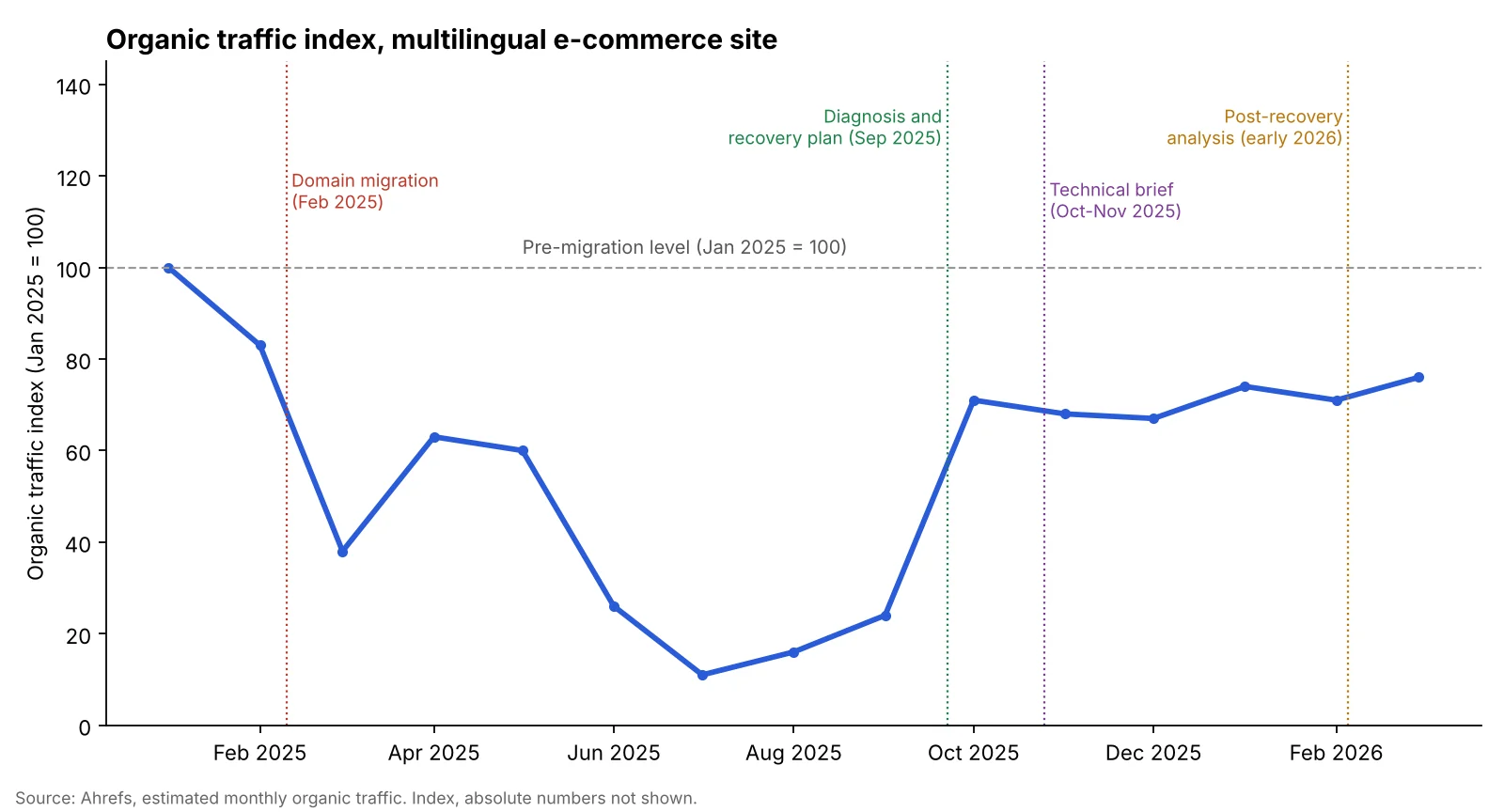
Situation. In February 2025 the company moved the site to a new domain. Organic traffic started to fall and by July 2025 was at 11% of the January level. In September 2025 the migration was reversed, and the client asked me to find out what had gone wrong and how to get the traffic back.
Diagnosis. I compared Search Console data for the weeks before and after the move. Three things stood out:
- Google processed the old domain correctly. Its pages dropped out of the index step by step.
- Right after the move, old-domain pages that never had traffic before started to get it. Google was looking for the closest match among old pages it had not yet reprocessed. Each page held the traffic for about a month, then lost it, and a different set of pages took its place.
- The new domain received very little. One article that performed well on the old domain got about three orders of magnitude less traffic on the new one.
My conclusion: Google did not merge the two domains. The new domain ranked as a separate site, without the authority and history of the old one.
Recovery plan. I expected at least half of the traffic to return on its own. To speed it up, I advised resubmitting the 20 most visited pages for reindexing by hand, sending the rest for reindexing in bulk, and reviewing the result after two weeks.
Technical brief. In October and November 2025 I ran a full site audit and wrote a 25-point brief for the development team. It covered broken internal and external links, pages blocked from indexing, hreflang errors, missing and overlong titles and descriptions, and heading structure.
Post-recovery analysis. In early 2026 I compared page-level clicks for November to January, year over year, across 15 language versions. Blog clicks fell by about 80%, while other pages lost about 20%. The German version accounted for most of the lost blog traffic. The analysis found new issues: Product markup on category pages, menu links to empty 404 categories in four language versions, subcategory canonicals pointing to the parent category, duplicate localized URLs, about 9,500 broken links across 20,000 crawled URLs, and about 13,000 noindex pages inside the hreflang setup. Each issue came with a recommendation.
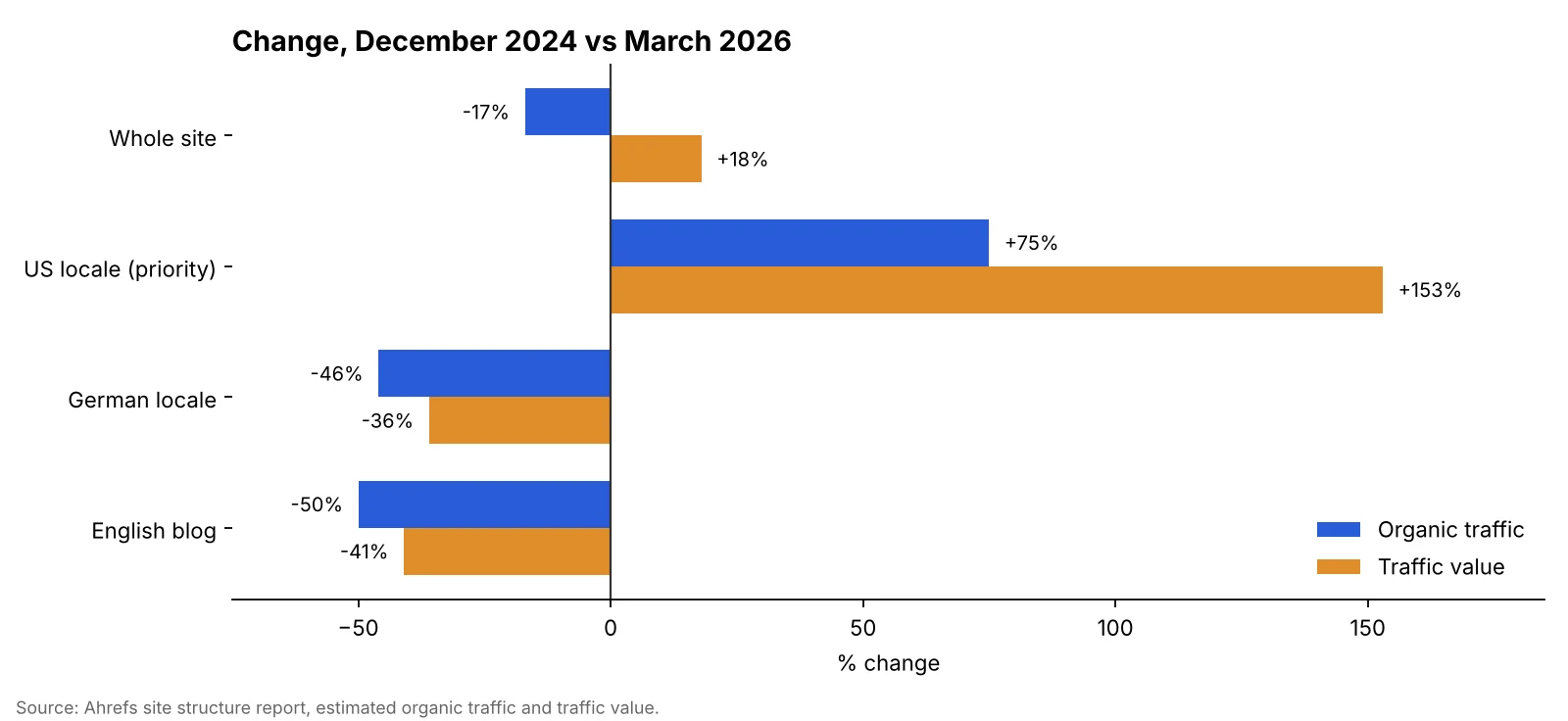
Result. After the reversal, estimated organic traffic returned to 71% of the pre-migration level in October 2025 and reached 76% by March 2026. Traffic volume tells only part of the story. Between December 2024 and March 2026:
- estimated traffic value for the whole site grew by 18%, while traffic fell by 17%;
- the US version, the priority market, grew by 75% in traffic and by 153% in traffic value;
- the main losses came from the German version (-46%) and the English blog (-50%).
In the same period Google expanded AI Overviews, which took a large share of informational clicks.
My role. Diagnosis, recovery plan, technical audit and brief, post-recovery analysis. The client's team decided on the reversal and owned the implementation.
Lessons
- After a domain change, watch the old domain as closely as the new one. Here the problem was visible in how Google treated the remaining old pages. Looking there early would have pointed to the cause much faster.
- Bring in an SEO before rolling a migration back. While the migration is live, the cause can still be found. After a rollback, the evidence is gone.
Working on a similar problem? Tell me about your site.